
You probably don't need another list of foods.
The structure that helps you follow the system long enough for your body to respond.
You have most likely been told what to do. Eat better. Lose the weight. Cut the sugar. Move more. You may even know exactly which foods are supposed to help.
So why is it still so hard to actually do it, week after week, when real life keeps happening?
Applications close soon · Five people selected · No program fee
This pilot is for adults who have been told they have fatty liver disease — NAFLD, MASLD, NASH or MASH — and who want a practical way to change what they eat.
Knowing is not the same as doing
Most people handed a fatty liver diagnosis are not short on information. Within a week they have read more about liver enzymes than their own doctor had time to explain. They know about the sugar, the seed oils, the processed food.
And then Tuesday arrives.
the work lunch · the supermarket · a label you can't read · the kids' dinner · a 4pm crash · eating out · travel · the weekend · the 10pm bowl of cereal
Everything arrives at once and nothing tells you what matters first. So you change six things, hold them for three weeks, drop four of them, and end up somewhere between guilty and confused about whether any of it was working.
The problem may not be that you lack information. It may be that nobody gave you an order to do it in.
Who is behind this
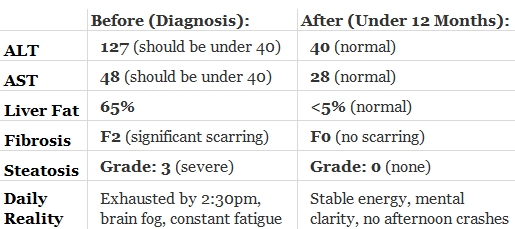
My name is Tim Dailey. I cooked professionally for twenty years, in kitchens ranked among the top hundred in the world, including Michelin-starred rooms. I was diagnosed with Stage 3 NASH — fat had accumulated in my liver to 65 percent, with F2 fibrosis. One step from cirrhosis.
I restored my liver function in under twelve months. No medications, no extreme diet. Food, sequence, and an unreasonable amount of research.
I am not a doctor and I am not a wellness coach. I am a person who had this specific problem, worked out a way through it, and wrote down what worked.
That writing became LiverWise. The tools have been in people's hands and the feedback has been consistently good — people tell me the ingredient work changed how they shop, that they finally understood why certain foods were a problem instead of just being told to avoid them.
And some of those same people still stalled.
Information can make the right decision easier. It does not make the right decision automatic.
The missing piece is implementation. Not more information — a sequence. What to do first, what to leave until later, and how to build it so it holds on the weeks when you have nothing left to give.
That part came naturally to me, and not because I am disciplined. Twenty years in professional kitchens is twenty years of building systems that have to work at eight o’clock on a Friday when everything is going wrong. You do not survive a service by knowing the recipes. You survive it because the prep was done in the right order, hours before anyone sat down.
That is what I built into these twelve weeks. It is the part nobody hands you with a diagnosis, and it is the part that makes everything else work.
What the twelve weeks give you
A twelve-module video course, one module a week, with the supporting material and the complete LiverWise Bundle alongside it. One focus at a time — not twelve changes at once. Everything below already exists.
01 Twelve video modules — one a week
The full course. Each module opens on schedule with the video, the supporting material, and that week's single focus.
You are not handed twelve weeks of content on day one and left to work out what to do with it.
02 The sequence the modules follow
The order counts! What to do in week one, what to leave completely alone until week six, and why that order is not arbitrary.
03 The complete LiverWise Bundle — yours to keep
The Matrix, the Harmful Ingredient Compass, and the Sneaky Six Decoder. The same system sold on its own, included here, and it stays yours after the twelve weeks whatever else happens.
04 The Matrix — what to actually eat
More than seventy foods organized across five liver pathways and scored. Your liver does not work through one mechanism — it works through five, and each needs different support.
This answers “what should I eat” without you researching a single thing.
05 The Compass — what to take out
Fifty ingredients across five categories, with a method for reading any label in about thirty seconds while you are standing in the aisle.
Not a list to memorize — a way of seeing.
06 The reset system
Something will go wrong. Not a risk — a certainty. This is what you do the morning after a bad day so it stays one bad day instead of becoming three bad weeks.
Taught in week five, before you need it.
07 A weekly check-in from me
Twelve emails, one each week, alongside the module. Each names that week's single focus and explains the mechanism before the instruction — because doing something you understand is a different experience from following an order.
08 Three calls with me, and my inbox throughout
In week one, week six and week ten. Twenty minutes each, and in between you can email me directly — not a support desk, not an autoresponder.
09 Your week-nine comparison
Week nine is when you get labs and set them against week one. What moved, what has not moved yet, and the order things tend to change in. Weight is last — energy, sleep and digestion come first, and knowing that in advance is what stops week six from feeling like failure.
The week-ten call lands right after this, so you are not left staring at a page of numbers on your own.
What you will not have to work out
You will still have to shop, cook, decide, and change what you do. The program cannot do that part and does not pretend to. What it removes is everything underneath it.
None of this is your job any more
• Which foods matter for a liver specifically, rather than for general health
• How to interpret an ingredient list you have never seen before
• What to change first, and what to leave alone until the first thing is automatic
• What to do when travel, a holiday or a difficult week disrupts everything
• Whether you are doing it right
• How to recover after a bad day without starting over
• What comes next
The research is done. The sequence is built. Your job is this week's one thing.
This is not for everyone
Buying another program is easy. Reading another guide is easy. Downloading another meal plan is easy. Changing what you actually do for twelve weeks is harder — which is why we are asking for commitment rather than selling you something.
Don't apply if
○ You are looking for another PDF to read
○ You are looking for a single food, supplement or trick
○ You cannot get labs through your own doctor
○ The next twelve weeks are too disrupted to hold one weekly habit
Do apply if
• You have the diagnosis and you want to make the changes
• Your numbers have not moved, or moved and then stopped
• You are willing to be honest about what does and does not work
Alcohol — remove it first. This program is designed for people who have removed alcohol. If that has not happened yet, that is the first step — before the diary, before the labs, before anything else on this page. Alcohol is a direct liver stressor. The program does not work around it.
What I am asking for in return
The program has no fee. What it costs you instead is your labs, your twelve weeks, and the right to talk about what happened — your results and your account of the experience, shared anonymously unless you tell me otherwise.
That is the whole exchange.
Your feedback does not need to be positive. It needs to be true.
If something is great or surprising, tell me. If something is confusing, unnecessary or missing, tell me. That is the most useful thing you can hand me, and it changes nothing about your deposit.
Video is welcome if you want to do it.
What it costs, and what is asked of you
There is no program fee
If you are selected, there is a $100 deposit — returned to you in full within 14 days of week twelve.
It comes back on two conditions: you submit your week-nine labs, and you complete the twelve weekly check-ins. That is all. It does not depend on any health outcome, and it does not depend on what you say about the program.
The deposit is not a price. A free commitment is the easiest thing in the world to abandon in week four — not out of laziness, out of life. A hundred dollars waiting on the other side of week twelve is a small weight on the right side of that decision.
If you are selected, you will be asked for
• Baseline labs before week one — ALT and AST at minimum, from the last three months
• Repeat labs at week nine, at your own cost, through your own doctor
• A short check-in each week, twelve weeks running
• A short questionnaire at the start and again at the end, so we can both see what changed beyond the labs
• An honest written account at week twelve
And permission to share it
Your results and your written account, used publicly. Anonymously by default — first name and age at most, never your full name or your face unless you specifically choose that. You sign one form covering it before week one, and you can withdraw it at any point.
What you say does not affect your deposit. That returns on your labs and your check-ins, whatever your account of the twelve weeks turns out to be.
None of it is collected now. The application asks for none of it. The deposit and the permission form come only if you are selected, and you can still say no at that stage.
Why only five
Because fifteen calls and an open inbox is what I can actually give five people, and it stops being true somewhere around six. This is not a mass-market course. I want enough contact with each person to learn what works and what does not — which is the entire reason I am running it this way.
How selection works
When applications close, I will read every one myself. Five people are selected — not at random, and not first come. I am choosing for the things that predict finishing: labs already in hand, alcohol already gone, and twelve weeks you can protect.
Everyone who applies hears back either way. If you are not selected, I will send you the 72-Hour Emergency Protocol and the first steps you can take on your own, at no cost. Nobody who raises their hand here leaves with nothing.
Apply for the pilot
Leave your name and email and you will be taken straight to the application. It takes about five minutes and asks about your diagnosis, your labs, and what you have already tried. No payment and no commitment at this stage.
Results vary. Individual outcomes depend on adherence, starting condition, and other health factors. This programme supports liver health — it does not diagnose, treat, or cure any medical condition. Always work with your healthcare provider.
LiverWise is not a medical practice. Tim Dailey is not a licensed medical professional. The content on this page is for educational purposes only and does not constitute medical advice.
BOOK A CONSULTATION
Enter your email address below and we'll reply ASAP!